Partner with the Next-Generation AI-Based
Operating System for Astrophysics
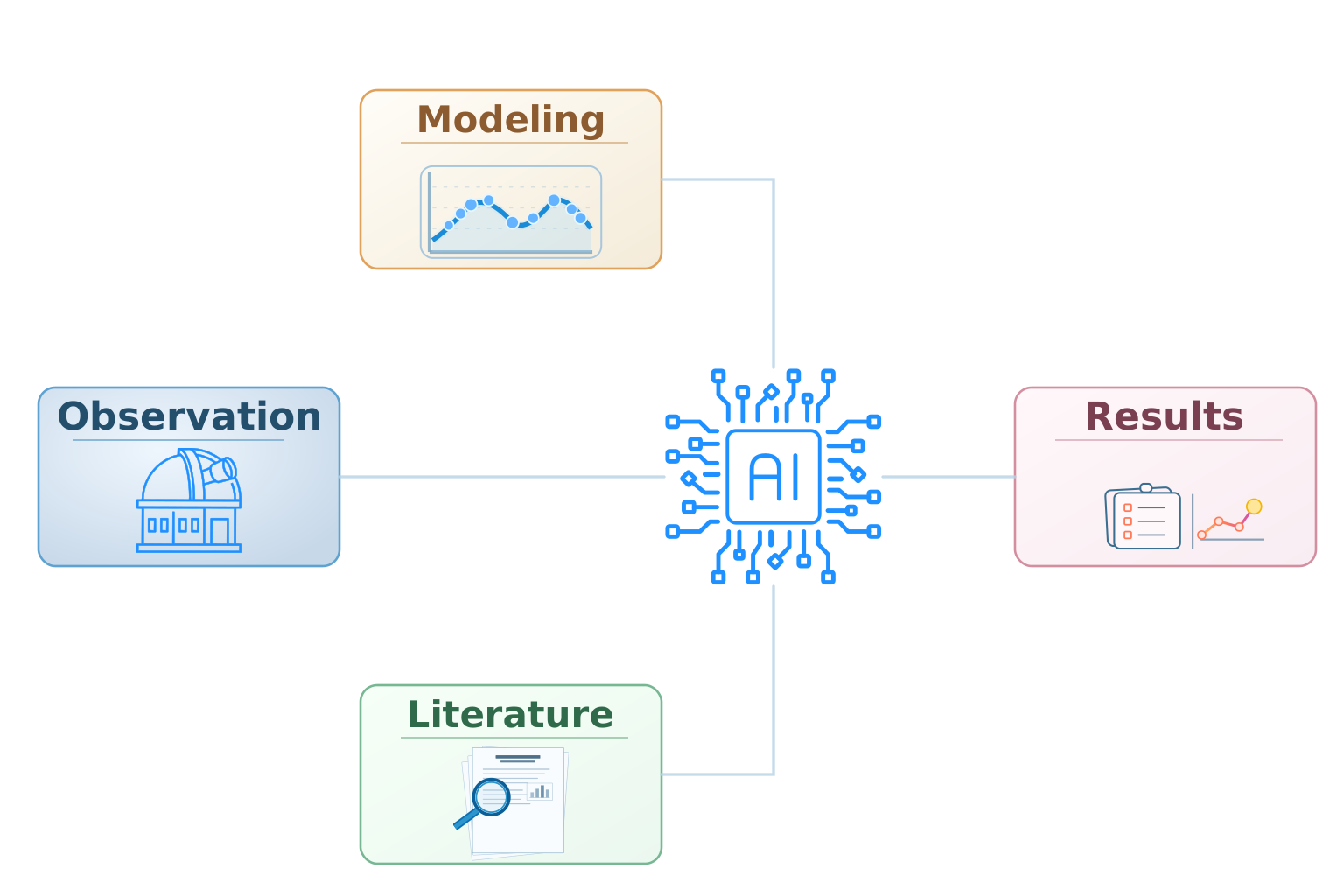
AstroGenesis is building the infrastructure layer for data-intensive astrophysics — unifying literature intelligence, observational data retrieval and modeling, and semi-autonomous research agents into a single research operating environment.
Strategic Thesis
Astrophysical research needs
an AI-native operating layer
The next decade of discovery will be constrained less by telescope access and more by infrastructure capacity. As data volume and model complexity accelerate, research workflows must evolve. AstroGenesis unifies intelligence, modeling, and agentic execution within a single operating environment.
Data Scale Challenge
Modern surveys and observatories generate multi-modal data at a scale that exceeds traditional sequential analysis workflows.
Workflow Fragmentation
Research teams operate across disconnected stacks for literature, observations, simulations, and interpretation — introducing friction and slowing iteration.
Need for AI-Native Infrastructure
Research operations should be orchestrated by agent systems trained on domain-specific data and physical priors, not stitched together ad hoc.
Institution Track
For Institutions
Structured partnerships focused on co-developing AI-native research infrastructure and advancing scientific discovery.
Research Acceleration
Semi-autonomous agent workflows for faster literature, data, and model iteration.
AI-Driven Data Modeling
Agent-driven analysis of raw astrophysical datasets.
Research Operating System
Unified workspace across papers, observations, and modeling.
Capital Track
For Strategic Investors
Infrastructure-scale opportunity with long-horizon defensibility anchored in proprietary data workflows, modeling architectures, and orchestration.
Infrastructure-Layer Thesis
Establishing the foundational AI layer across astrophysical research domains.
Proprietary Neural Models
Domain-trained neural models for interpreting raw astrophysical signals at scale.
Expansion Across Domains
Scalable expansion from blazars into time-domain and multi-messenger research.
Roadmap
Path to Full Astrophysical Infrastructure
A phased roadmap showing how AstroGenesis scales from domain-specific execution to full-stack scientific infrastructure.
Phase 1
Blazar-focused neural modeling + agent workflows
Initial infrastructure deployment anchored in blazar science, integrating literature reasoning, data retrieval, neural network–based emission modeling, and coordinated agent workflows. Establishes a modular execution core capable of incorporating new data modalities, model families, and analytical capabilities as the system evolves.
Phase 1.1
Raw data pipeline integration
Extension of the core system to connect raw observational data pipelines, enabling ingestion, calibration-aware processing, and alignment with modeling workflows. This phase bridges instrument-level data handling with higher-level scientific reasoning.
Phase 2
Expansion to GRBs
Extension of pretrained model families and agent orchestration to fast transients, introducing time-critical reasoning, burst-scale data handling, and cross-instrument synthesis under strict temporal constraints.
Phase 3
Expansion to TDEs
Extension of pretrained model families and agent orchestration to fast transients, introducing time-critical reasoning, burst-scale data handling, and cross-instrument synthesis under strict temporal constraints.
Phase 4
Full astrophysical operating infrastructure
A unified AI-native scientific environment spanning literature, raw and processed observations, model execution, and autonomous hypothesis iteration across astrophysical domains. Enables continuous, reproducible scientific workflows without fragmentation between tools, data layers, or reasoning stages.
Get in Touch
Engage with AstroGenesis
Reach out to discuss research collaboration, infrastructure integration, or strategic alignment, including long-term support and investment. Inquiries are reviewed by the team.